


Ottawa, January 23, 2026 — The Professional Institute of the Public Service of Canada (PIPSC) is warning that cuts announced this week to key federal science-based departments will weaken Canada’s ability to prevent disasters, respond to emergencies, and protect public safety and the environment.
Reductions at Environment and Climate Change Canada (ECCC), Transport Canada (TC), Fisheries and Oceans Canada (DFO), and Innovation, Science and Economic Development Canada (ISED) target scientists, engineers, and policy experts whose work underpins dangerous goods regulation, rail safety, weather forecasting, pollution prevention, marine conservation, habitat restoration, and environmental disaster response.
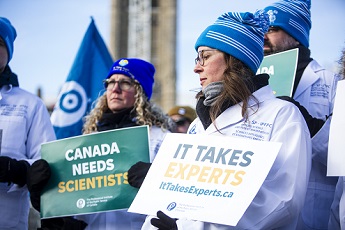
“These are not abstract programs or administrative redtape,” said Sean O’Reilly, President of PIPSC. “These are the experts who prevent oil spills from becoming catastrophes, who ensure dangerous goods don’t explode on our railways, who make sure Canadians can trust weather warnings, and who protect species from extinction. Cutting this scientific expertise puts public safety and the environment at risk.”
The cuts come on the heels of a 2025 PIPSC report warning that Canada’s federal public science system is already at a breaking point. A Science Roadmap for Canada’s Future: Lessons from a Decade of Federal Scientists’ Voices, drawing on 12 years of data from thousands of federal scientists, shows collapsing funding, shrinking capacity, and declining confidence in evidence-based decision-making – and calls for immediate reinvestment, not deeper cuts.
“Canadians have seen the cost of failing to invest in science, regulation, and oversight,” said Bryan Van Wilgenburg, President of PIPSC’s Applied Science and Patent Group (SP Group) and employee at ECCC. “The collapse of the Atlantic cod fishery, the Sydney Tar Ponds – Canada’s most notorious toxic waste site, and the Lac-Mégantic rail disaster that killed 47 people were not acts of nature. They were failures of oversight, investment, and evidence-based decision-making – exactly what these cuts are stripping away.”
PIPSC is calling on the federal government to protect the scientific, engineering, research, and regulatory expertise that protects Canadians, their communities and the environment – now and for future generations. “We need to invest in science, not divest”, reiterated O’Reilly.
PIPSC represents over 85,000 public-sector professionals across the country, most of them employed by the federal government. Follow us on Facebook, on X (formerly known as Twitter) and on Instagram.